Second Great Awakening
Under the Banner of HeavenThe Second Great Awakening was a wave of religious experimentation and revival that reshaped the United States in the first decades of the nineteenth century. In the book, it is more than background to Joseph Smith’s career: it is the volatile environment in which new prophets could claim authority, the end of history could feel close, and Mormonism could take shape as an enduring American faith.
A Nation in Religious Ferment
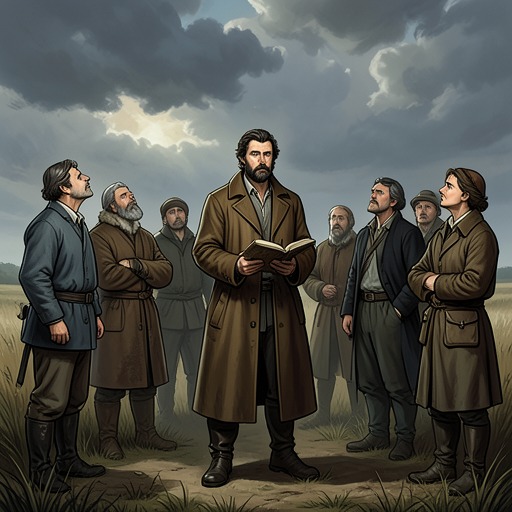
After the Revolutionary War, established churches seemed spiritually exhausted to many Americans. The resulting upheaval reached especially intense levels near the expanding frontier. In western New York, where Joseph Smith came of age, religious fervor was so pronounced that the region around Palmyra, New York, became known as the burnt-over district.
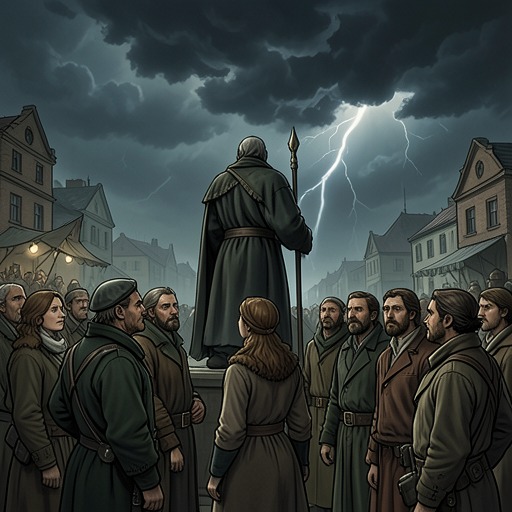
The period’s spiritual atmosphere combined competing religious claims with an expectation that ordinary history might soon give way to a transformed world. The apocalypse seemed near, and the millennium was widely anticipated within a generation or two. Against this horizon, religious experimentation could offer both an account of present uncertainty and the promise of an approaching age of peace. The book compares this ferment to the religious upheaval of the 1970s, while distinguishing the earlier period’s particular setting and beliefs.
Joseph Smith and a New Faith
Joseph Smith grew up amid this contest of churches and claims to spiritual knowledge. He had little formal schooling, but the book describes him as intellectually nimble, imaginative, sociable, and gifted at holding an audience. His interest in religious questions developed alongside a youthful involvement in folk magic, including attempts to locate buried treasure through crystal gazing. The narrative treats that history not as incidental color but as part of the religious world from which his later movement emerged.
The book sets Joseph’s achievement against the many persuasive prophets and new creeds that circulated during the Second Great Awakening. Most of those movements did not leave behind enduring bodies of followers. Mormonism did. The account identifies Joseph’s powerful personal charisma as a major reason his religion attracted adherents when so many competing faiths faded. That appeal carried a tension: charisma could bind followers to a shared religious vision, but the authority it concentrated in a prophetic leader also had the potential to become dangerous.
From Revival to Institution
The movement’s later history shows how a new religious claim could acquire civic and organizational power. In Nauvoo, Joseph stood at the head of a city whose unusual charter gave it extensive powers. Within five years of the settlement’s founding, more than fifteen thousand Saints lived in and around the city. Joseph was formally elevated as a ruler over Israel on earth, commanded the Nauvoo Legion, and sought even greater military authority before announcing his candidacy for president of the United States in January 1844. These developments were not simply revival meetings: they show the transformation of prophetic leadership into an ambitious religious and political order.
After Joseph’s murder, the conflict over leadership and the community’s future intensified. A month after the trial of his killers ended in acquittal, Brigham Young declared that God and his people were responsible for avenging the murdered prophets. Church authorities then incorporated an Oath of Vengeance into the temple endowment ceremony. Participants pledged to pray for vengeance and to teach that obligation to their descendants; the oath remained in the ceremony until 1927, when its exposure in the non-Mormon press provoked public and political criticism. A revivalist movement had developed rituals capable of carrying its grievances across generations.
The migration west further strengthened collective identity and loyalty to church leadership. By the Saints’ arrival in the Great Salt Lake Valley in 1847, hardship and displacement had separated many who wavered from those who completed the journey. The book describes the survivors as bound together by adversity and unconditionally loyal to Brigham Young. During the trek, plural marriage was first shared openly with ordinary members at a snowbound camp at Sugar Creek, Iowa, even as church leaders continued to deny the practice to outsiders. Revivalist conviction thus travelled alongside secrecy, communal discipline, and the construction of a lasting settlement.
Later Gatherings and Institutional Legacies
The book also places the movement’s beginnings beside later forms of Mormon communal life. At the Hill Cumorah Pageant, more than ten thousand people gather for a production staged each summer since 1937. Although the pageant welcomes nonmembers and is intended in part to support conversion, more than 95 percent of its audience already belongs to the church. In practice, it serves largely as a gathering at a place associated with the faith’s origins, where members celebrate shared testimony. Its scale and spectacle show how religious origins can be continually made present through collective performance, even though the pageant itself belongs to a later era.
Other later examples emphasize how prophetic authority could also regulate daily life and mark sharp boundaries between insiders and outsiders. In Colorado City, followers of Rulon Jeffs were forbidden to watch television or read newspapers, and contact with people outside the United Effort Plan was prohibited, including contact with family members who had left the faith. When DeLoy Bateman stopped attending priesthood meetings, the community’s leader ordered that his wives and children be taken from him; both wives refused to leave, and most of the family became apostates. These events belong to a later fundamentalist setting, not to the Second Great Awakening itself. They nevertheless show one possible historical afterlife of intense prophetic authority: a religious community’s rules could reach beyond belief into information, family ties, and the consequences of dissent.
The Second Great Awakening, as presented here, is therefore both a historical setting and a source of momentum. Its religious ferment made room for Joseph Smith’s distinctive claims; the movement he founded then outlasted the revival climate that helped produce it. The later institutions, rituals, settlements, and disputes in the book reveal how that initial opening could generate enduring solidarity as well as concentrated authority and exclusion.